Platform independence is the next infrastructure play
When I work with companies on their marketing stack, one of the first things I do is audit their software subscriptions. And every single time, the same pattern emerges - bloated tooling, unused licences, and a quiet dependency on platforms that have been raising prices for years while delivering diminishing marginal value.
This isn't primarily a sovereignty argument. I know the geopolitical angle gets a lot of airtime - and yes, there are risks when your entire operating system runs on American software and an unpredictable administration sits in Washington. But the real threat is not that your cloud provider is made unaccessible for you (until capitalism is defeated, you're mostly safe - although the recent Fable saga might be a counter argument!). The real threat is that a new AI model drops tomorrow that is 10x better than what your current tools are locked into, or a technology shift - and you just can't move.
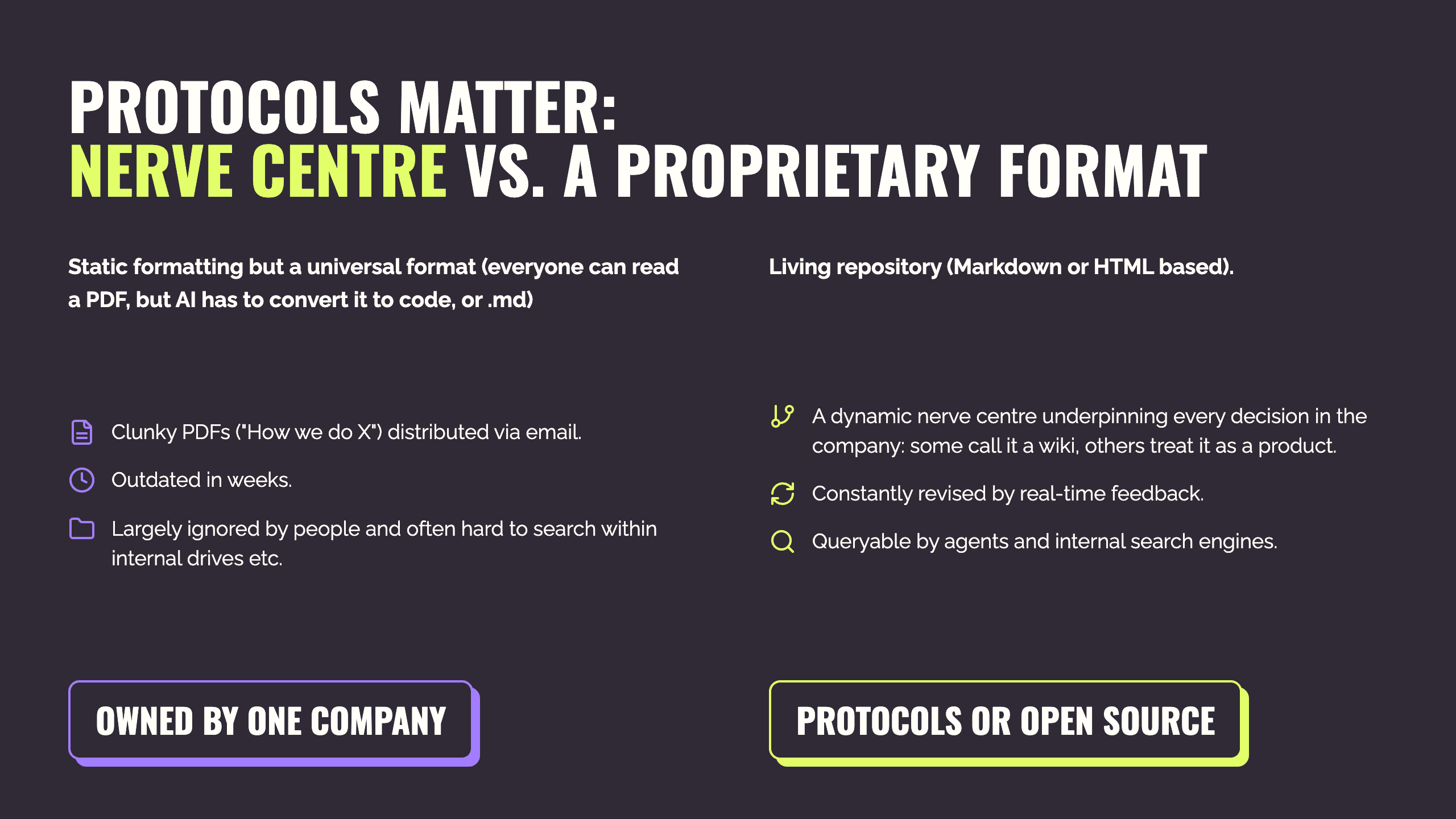
In this context, you need interoperability. You need to get ready for the next wave, whatever that next wave looks like. (Also see: Beyond AI tools: building a knowledge base business)
When I started working in venture capital some 10+ ago, building software was made by product crafters, not business minds. I vividly remember the premium of using Citymaper over Google Maps because it was simply a better product. But times have changed.
Today you're not paying for software anymore... you're paying for rent. And your landlord is getting greedy :)
The CRM market reveals the pattern most clearly
I spend a lot of time in this space, so let me use it as a concrete example. More than $500 million in venture capital flowed to CRM challengers in 2024-2025 alone - signalling massive investor conviction that the market is ripe for disruption. And the challengers are coming from fundamentally different angles than the incumbents.
- Open-source CRMs like Twenty offer full data ownership and self-hosting.
- AI-native CRMs are building from scratch rather than retrofitting. Attio positions as the first AI-native CRM. Day AI auto-generates action items from email, Slack, and meetings.
Then there's OpenAI's Frontier, which promises an enterprise AI agent platform operating on top of Salesforce and other legacy systems - potentially disintermediating the CRM layer entirely. But I've been around long enough to recognise this marketing trick. As much as I want Salesforce to be replaced, I absolutely do not want an LLM company's product to become my "everything app", holding all my personal and business context hostage.
The lesson from the CRM industry applies everywhere: the more dependent you are on a proprietary platform, the more exposed you are when the category gets disrupted. And it will.
Three pathways to platform independence
I think about this as three distinct strategies that aren't mutually exclusive - most companies will use a blend.
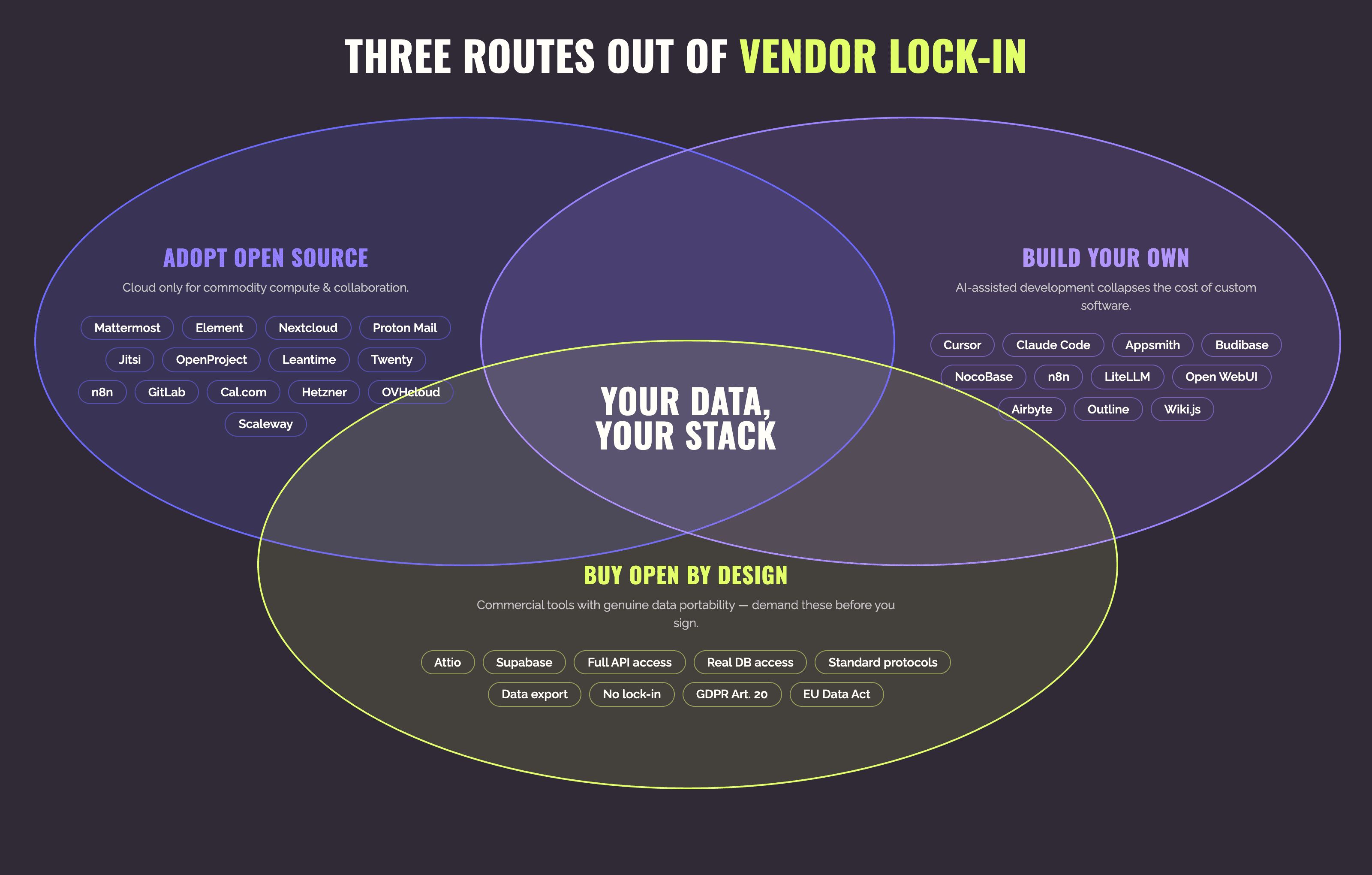
Path 1: Open-source stacks with cloud for commodity compute and collaboration features only.
| Use case | Proprietary incumbent | Open-source / independent alternative |
|---|---|---|
| Team messaging | Slack, Microsoft Teams | Mattermost, Element/Matrix |
| File storage & docs | Google Workspace, OneDrive | Nextcloud |
| Gmail, Outlook | Proton Mail (50K+ organisations), Tutanota | |
| Video conferencing | Zoom, Google Meet | Jitsi Meet |
| Project management | Asana, Monday | OpenProject, Leantime |
| CRM | Salesforce, HubSpot | Twenty |
| Workflow automation | Zapier, Make | n8n |
| Version control | GitHub | GitLab |
| Scheduling | Calendly | Cal.com |
| Cloud infrastructure | AWS, Azure, GCP | Hetzner, OVHcloud, Scaleway |
Governments are validating this path at scale - and that matters, because governments are typically risk-averse adopters. Germany's openDesk - a full open-source workplace suite integrating Element, Nextcloud, Collabora Online, OpenProject, and Jitsi - now serves 70,000 users. The International Criminal Court adopted openDesk after US sanctions disrupted their Microsoft access. France mandated Tchap (Matrix-based government messaging) for all government communications in April 2025, banning WhatsApp, Signal, and Telegram for civil servants - with 600,000+ active monthly users.
Path 2: Build your own with AI-assisted development
| Use case | Instead of buying... | You can build with... |
|---|---|---|
| Internal dashboards | Retool, Metabase | Cursor, Claude Code + open-source frameworks |
| Custom CRM / pipeline tools | Salesforce | Low-code: Appsmith, Budibase, NocoBase |
| Workflow automation | Zapier (per-task pricing) | n8n + custom scripts |
| Internal AI tools | ChatGPT Enterprise ($60/user/month) | LiteLLM + open-source UI (e.g. Open WebUI) |
| Data pipelines | Fivetran, Airbyte Cloud | Self-hosted Airbyte, Singer taps |
| Knowledge bases | Notion, Confluence | Outline, Wiki.js |
The cost of custom software development is falling dramatically - and this changes the build vs. buy equation in a fundamental way. The evidence on AI coding productivity is more mixed than vendor marketing suggests. Still today, the most credible impact is in prototyping and MVPs - dramatically reducing the cost to test whether a custom tool is viable before committing to a full build. But companies like Klarna are at war with software, rightfully so!
Path 3: Open commercial solutions with genuine data portability
| What to look for | What this means in practice | Examples |
|---|---|---|
| Full API access | Every data point readable and writable via API | Attio (open API, programmable App SDK) |
| Real database access | Direct access to underlying database, not just API | Supabase (full Postgres access) |
| Standard protocols | CalDAV, CardDAV, IMAP, WebDAV, Matrix | Nextcloud, Proton, Element |
| Data export | Complete dataset exportable in standard formats | Required by GDPR Article 20, enforced by EU Data Act |
| No vendor lock-in clauses | EU Data Act (effective September 2025) explicitly prohibits lock-in for cloud services | Utah's Digital Choice Act (effective July 2026) is first US state equivalent |
Not every company can or should self-host everything. The third pathway uses commercial software that prioritises genuine openness - full API access, real database access (not just API access), GDPR-compliant data export, and standard protocols. Can you export your complete dataset and move to a competitor or self-hosted alternative within days, not months? If the answer is no, you are renting your freedom.
The local-first movement and why it matters architecturally
There's a deeper technical movement underpinning all of this that I think is worth understanding - even if you're not a developer. The local-first software movement provides the architectural foundation for platform independence. The core principle: the primary copy of data lives on users' devices, with cloud used for sync rather than as the source of truth. If the vendor disappears, your software and data continue working for you. That's mainly why I use Obsidian as my everything app (which is a UI layer on top of a simple filebase system) - I am a former Evernote user, and I remember how betrayed I felt when a PE shop took over and suddenly raised prices and destroyed the product I was spending hours on every day.
I have long thought that business applications as we know them will simply collapse as databases with business logic migrate into the AI agent tier. When that happens, seat-based pricing will become obsolete.
I have long thought that business applications as we know them will simply collapse as databases with business logic migrate into the AI agent tier. When that happens, seat-based pricing will become obsolete.
The companies that will compound value over the next decade are those that own their infrastructure, own their data, and can adapt to technological shifts without permission from their vendors. Platform independence is not rejecting the cloud, but ensuring that your technology stack serves your business strategy - rather than constraining it.
In a world where the cost of AI changes all of the time and new models emerge monthly, the ability to move fast - unconstrained by vendor lock-in - is the ultimate competitive advantage. You wouldn't build your house on a rented land. Why would you build a company on rented infrastructure?